|
 |
 |
|
|
| Manual / Automatic Breast Pumps |
| Baby Products > Breast Pumps |
|
 |
|
"Breast is best." Breast milk is recommend for a baby's first six months, unless there's a medical reason not to do so, without supplementing with water, formula, or juice. Breast-feeding is convenient there are no bottles to prepare and warm and it's free! With so many breast pumps to choose from these days, knowing which pumps are best can really help you make a good choice for your little one. HealthCheckSystems is committed to providing mothers with the best quality, Cost efficient breast pumps and pumping supplies available. |
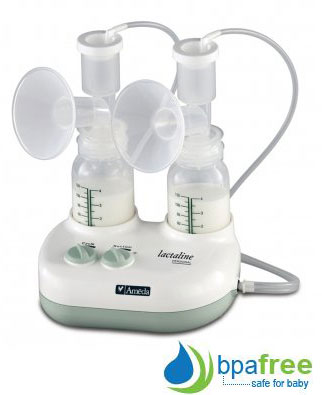 |
| Ameda |
|
|
|
|
|
|
|
|
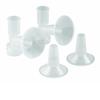 |
Ameda 17155 Dual HygieniKit Collection System BPA FREE
Price: $49.96
Free Shipping
Ameda's exclusive patented Ameda HygieniKit, creates one of the most effective milk collection systems available today. It helps mothers provide the purest milk possible to their babies. The kit?s unique silicone diaphragm acts as a barrier, separating the user from the suction source. BPA Free!
|
|
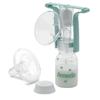 |
Ameda 17066P One Hand Breast Pump with Flexishield
Price: $59.95
Free Shipping
This Ameda pump is so compact it fits into a purse. The patented, easy-to-use design provides control and flexibility simply by varying the frequency and degree of the handle squeeze. The handle assembly eliminates the need for electrical outlets or batteries. The one-hand design allows you to pump one breast while baby nurses on the other, or by using two breast pumps, you may dual pump to save precious time
|
|
|
| Playtex |
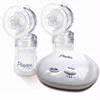 |
Playtex Petite Double Automatic Breast Pump System
Price: $84.95
Free Shipping
The Playtex Petite Double automatic breast pump is a lightweight compact automatic breastpump,designed for frequent use. Features Soft Comfort silicone cup that moves in and out, massaging the breast just like baby. 3 levels of suction strength. Economically priced. |
|
|
All Ameda breast pumps are BRAND NEW and come in the
manufacturer's factory sealed box
FREE UPS Ground Shipping on Breastpumps!
(continental USA only)
|
Breast pump buying guide
TypesBreast pumps come in these basic types: large, hospital-grade, dual-action, which typically aren't available for sale (you rent them from the hospital where you deliver or from a lactation or rental center); midweight, personal-use, automatic models that are comparable to hospital-grade pumps and can travel with you; small electric or battery-operated units that double- or single-pump, and one-handed manual pumps. There's even a "hands free" pump that you can strap around your waist that operates while you work or relax. Here's the lowdown on each.
Electric Breast pumpsElectric powerhouses are about the size of a car battery and can weigh 5 to 11 pounds. Manufactured for users in hospitals and for those who choose to rent, they have sensitive controls that allow you to regulate suction rhythm, intensity, and pressure. Some have a pumping action that's almost identical to a baby's natural sucking, which can help to build and maintain your milk supply. A hospital-grade pump can cut pumping sessions in half--to just 15 minutes with a dual pump, which empties both breasts at once. These are expensive to buy, but you can rent them from hospitals, medical-supply stores, lactation consultants, drugstores, and specialty retail stores. Choose this option if nursing is difficult because your baby has trouble latching on, if you're not sure how much you'll need a breast pump but you want one on hand just in case, if you plan to pump for three months or less from home, or if you must dramatically increase your milk supply and need the power of a hospital-grade pump.
Midweight, personal-use, automatic Breast pumpsUsually no bigger than a briefcase and weighing around 8 pounds or less, these electric breast pumps typically are lighter and slightly less efficient than the hospital-grade models. Like a hospital-grade pump, a personal-use automatic can slash pumping time because it has a powerful motor and serious suction. Many personal-use automatic pumps have suction that mimics a baby's natural sucking, which typically begins with rapid, high-frequency suction and changes to a slower, suck/swallow pattern. This mimicking fosters faster milk flow, although some pumps use a constant vacuum, with self-adjusting suction settings. Intermittent action better imitates a baby than a constant vacuum--and it's probably easier on you, too. Many models come housed in a black microfiber shoulder (a.k.a. "Metro") bag or backpack, which is ideal if you're working outside your home. They're often equipped with an adapter for your car's cigarette lighter or a battery pack for times when you're not near an electrical outlet. They may come with all necessary attachments, including removable cooler carrier and cooling element, battery pack, AC adapter, and collection containers, lids, and stands. Choose this option if you'll be returning to work full- or part-time and you need to pump throughout the day to maintain your milk supply and express milk for missed feedings.
Small electric or battery-operated unitsUsing widely available AA or C batteries or household current, these lightweight, compact devices can fit discreetly into your purse or briefcase. They're relatively quiet, but the suction can be sluggish, although the vacuum on some models can be regulated for maximum comfort. Others, though, have a constant vacuum that can cause nipple discomfort. Choose this option if you need to pump only occasionally because you'll be away from your baby now and then--for a night out or for a couple of hours during the day.
Manual Breast pumpsWith these small pumps, you produce the suction yourself by squeezing a bulb or lever or by manipulating a syringe-style cylinder. There are many designs of manual pumps on the market. Cylinder, or piston-style, pumps usually allow you to control pressure and minimize discomfort. Some manual models can be operated with one hand. They're easier to use than those requiring one hand to hold, one to pump. Choose this option if you're a stay-at-home or work-from-home mom and you need to miss only a rare feeding because of a night out; if you're traveling, or you have plugged milk ducts or sore nipples. A manual pump is also ideal for pumping on the go, in places where electricity may not be available. Look for one with an ergonomic handle, not a bulb, though any small pump could tire your hand and arm and cause repetitive strain injuries if you use it frequently.
Hands-free pumpsChoose this option if your schedule is hectic and you like the idea of being able to do something else while pumping. One such model, Medela's Freestyle, is a rechargeable, double electric pump. The breast shields attach to a nursing bra, the hands-free kit attaches to the top clasps of most nursing bras. (We haven't tested this product.) Note: Many regular breast pumps can be made hands-free with a special pumping bra.
|
About Breast pumps
As you probably know, these days, "breast is best." The American Academy of Pediatrics, as well as a number of leading professional organizations, including the Academy of Breastfeeding Medicine and the World Health Organization, recommend breast-feeding for the first six months of a baby's life, unless there's a medical reason not to do so, without supplementing with water, formula, or juice.
If you want to continue breast-feeding nonexclusively after that, these groups say all the better. That's because breast milk--custom-made nourishment specially formulated by Mother Nature--offers so many benefits: It boosts your baby's immune system, promotes brain development, and may reduce your child's risk of Sudden Infant Death Syndrome (SIDS) as well as diabetes, some types of cancer, obesity, high cholesterol, and asthma later in life. Breastfeeding helps moms return to their pre-baby weight faster, and may decrease the risk of breast and ovarian cancer, and even osteoporosis.
Breast-feeding is convenient--there are no bottles to prepare and warm--and it's free! There's no formula to buy, which can run you up to an average of $124 per month, depending on the type of formula you buy. But unless you plan to take your baby with you wherever you go and the process always goes smoothly, you'll probably need a breast pump. In fact, a pump can be indispensable for nursing mothers in a number of scenarios: You want to continue breast-feeding but return to work; you need to formula-feed your baby temporarily for medical reasons but want to resume breast-feeding when you get the go-ahead from your doctor; or you need to miss a feeding occasionally because you're traveling or otherwise away from your baby.
A breast pump may come in handy during those first few days after you've delivered, when the breasts can become so full that a baby may have trouble latching on. Things can be sailing along in the hospital, but when you get home, supply can outpace demand. The solution is to express some milk with a breast pump--and to have one on hand before your baby is born, so you're ready to go as soon as you return home after delivery. A breast pump also allows you to store milk (in bottles or storage bags) for later, then bottle-feed it to your baby or mix it with a little in cereal when she reaches the "solid" food stage at around 6 months.
You can refrigerate breast milk safely for 24 hours, or freeze it for three to six months. A housekeeping note: Date it when you freeze it and store it in the back of the freezer, not in the door. That's a warm spot that can prompt thawing every time the door is opened. When the time comes to use it, thaw breast milk in warm water. Don't boil or microwave it; both of those heating methods can destroy valuable immunological components that make breast milk the liquid gold it is. Microwaving can create uneven "hot spots" that can scald a baby's mouth and throat.
There are several types of breast pumps available--from large, hospital-grade pumps and midweight personal-use automatic pumps to small, lightweight, and easily portable manual models that work one breast at a time. You'll want a pump that's appropriate to your particular situation. Pumping can be time consuming and just one more thing to do, but it shouldn't be painful or frustrating. Choosing the right pump can make the difference between meeting your breast-feeding goals and having to stop short.
A baby's natural sucking rhythm is 40 to 60 cycles per minute (one pull per second or a little less). Hospital-grade and personal-use automatic pumps typically operate at 30 to 50 cycles per minute. Other pumps are usually less efficient. As a general rule, the more suction and releases per minute a pump provides, the better it will be at stimulating your milk supply. Efficiency is especially important if you plan to save a large quantity of milk. If you're returning to work, for example, you'll need to have much more breast milk on hand than if you stay home with your babies or are supplementing breast milk with formula.
Once you find the right pump, using it will take a little practice. You'll need to learn how to position it correctly and adjust the suctioning to get the best results. Don't worry--with the right pump, you'll soon get the hang of it. Pumps require some assembling and disassembling for cleaning. Wash any parts of the pump that touch your breasts or the milk containers in the dishwasher, or with hot, soapy water. Drain them dry before each use.
this info is from consumerreports dot org
| Compare the Models |
| Manufacturer |
AMEDA |
- |
PLAYTEX |
| Pump Name |
Purely Yours Ultra |
Purely Yours |
Isis Duo |
Petite |
| Features |
| Type |
Personal |
| Double Pump |
Yes |
| Adjustable Speed |
Yes |
| Adjustable Suction |
Yes |
| Pump 1 Side |
Yes |
NO |
Yes |
| Soft Flange |
Yes |
NO |
Yes |
| Closed System |
Yes |
NO |
Yes |
| Uses Standard Bottles |
Yes |
NO |
Yes |
| Personal Kit Included |
Yes |
NO |
| Manual Attachment |
Yes |
NO |
| AC Adapter |
Yes |
| Carrying case |
Yes |
NO |
| Milk Storage Unit |
Yes |
NO |
| Hands Free |
NO |
| Vehicle Adapter |
Yes |
NO |
| Battery Powered |
Yes 6 AA |
NO |
| Extra Parts Available |
Yes |
| Suction Range (mmHg) |
50-200 |
50-200 |
20-220 |
50-200 |
| Weight lbs |
9 |
11 |
10 |
6 |
�
|